
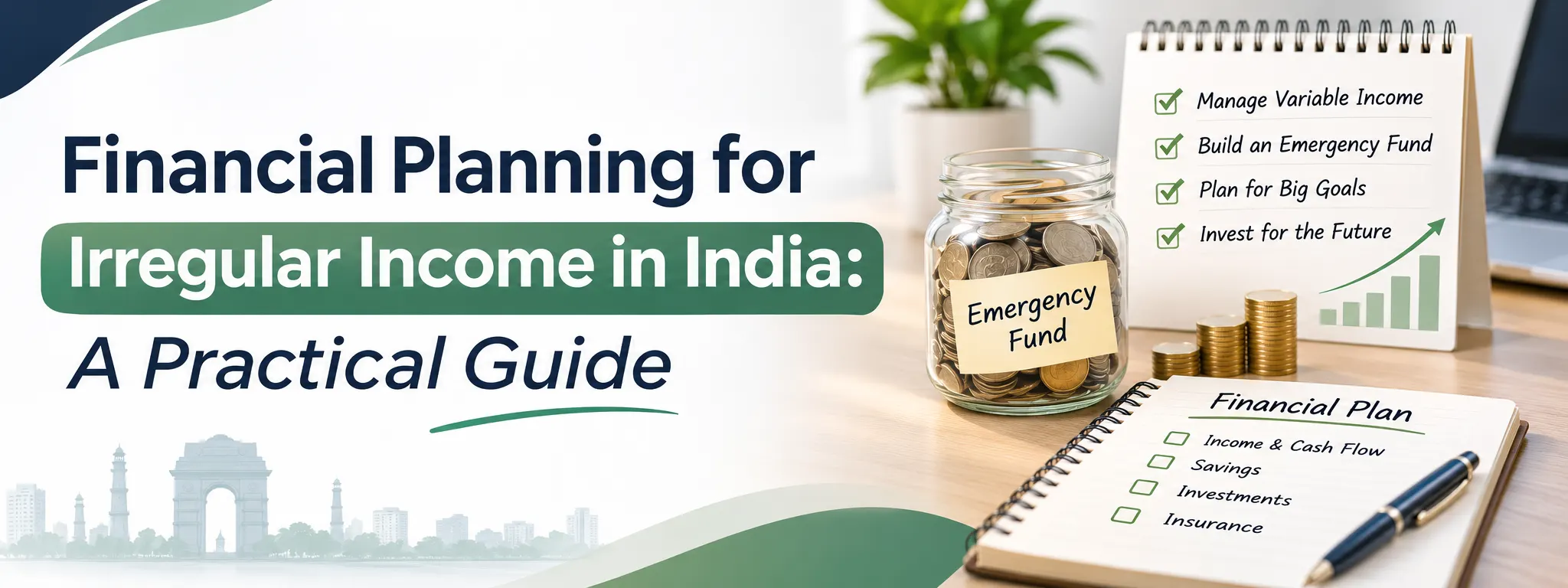
To plan finances on an irregular income in India, base your budget on your lowest typical month, pay yourself a fixed amount from a separate account, keep a larger emergency fund, buy your own insurance, and invest through a small SIP that you top up in strong months.
Financial planning for irregular income in India works differently from salary-based planning. When money arrives on no fixed date and in no fixed amount, an ordinary monthly budget falls apart the first time a client pays late. Here is a simple way to bring some order to it. This guide sits alongside our overview of financial planning services in India.
Who has an irregular income?
Most budgeting advice is written for people with a salary, but plenty of earners don't have one. That includes:
• Freelancers, consultants and creative professionals
• Shop owners, traders and wholesalers
• Commission and incentive-based sales professionals
• Contractors, gig workers and project-based earners
• Seasonal businesses with busy and slow periods
If your earnings swing from month to month, the steps below are written for you.
Why planning is different when income is irregular
Salaried people receive a predictable amount on a predictable date, and often get employer benefits such as Employee Provident Fund, gratuity and group insurance. With irregular income:
• You cannot be sure what next month will bring, so fixed commitments like rent, EMIs and school fees need a safety net.
• There is no employer contribution towards retirement or insurance, so you must arrange both yourself.
• Tax payments can be lumpy and need to be planned, not paid in a rush.
• It is easy to overspend in good months and freeze investing in lean ones.
None of this needs a complicated system. A few habits cover most of it.
Step 1: Find your baseline number
Your baseline is the amount you can count on even in a slow month. Here is how to work it out:
1. List your income for the last 12 months.
2. Note the lowest three months and take their average. This is a safe baseline.
3. Add up your essential monthly expenses such as rent or EMI, groceries, utilities, school fees and insurance premiums.
Plan your life around the baseline, not around your best month. Everything above it is surplus.
|
Type of expense |
Examples |
How to treat it |
|
Fixed essentials |
Rent, EMI, school fees, insurance premiums |
Must be covered by your baseline |
|
Flexible spending |
Dining out, travel, shopping |
Pay only from surplus months |
|
Irregular but predictable |
Annual premiums, advance tax, festival and wedding spends |
Set aside a fixed amount every month |
Popular rules such as the 50-30-20 rule assume steady income. If you use them, apply the percentages to your baseline, not to your best month. For a broader refresher, see our guide to financial budgeting.
Step 2: Pay yourself a fixed monthly amount
If you only take one habit from this guide, take this one.
• Keep all business or client receipts in one holding account.
• On a fixed date each month, transfer a fixed amount to your personal account. Think of it as your own salary.
• Whatever stays in the holding account becomes your buffer for lean months.
Separating personal and business money also makes it far easier to see what you really earn and what you can safely invest.
Step 3: Build a bigger emergency fund
Aim for at least six months of essential expenses. Go higher if you have dependents, large fixed commitments or very uneven work, because a slow patch can last longer than a single month.
Keep this money in easily accessible options such as a savings account or low-risk, liquid-type options, not in volatile investments. An emergency fund is a safety net, not an investment. To understand the difference, read savings vs investments.
Build it in your strong months first, before increasing investments.
Step 4: Arrange your own protection
Without an employer, nobody else covers you. Two things matter most:
• Term life insurance if anyone depends on your income.
• Health insurance with adequate cover for you and your family.
A single hospital bill can undo years of saving, which is why protection comes before aggressive investing. Learn how it fits together in how insurance fits into your financial planning, and check how much health insurance cover you actually need. You can also explore our life insurance and health insurance services.
Step 5: Invest with a base SIP and top-ups
Irregular income doesn't rule out regular investing. What tends to work:
• Start a SIP sized to your baseline surplus, so it stays comfortable even in lean months.
• In strong months, add a lump sum top-up.
• Most fund houses let you pause a monthly SIP for 1 to 6 months, usually if you ask two to three weeks before the instalment date. Rules differ by fund house, so check the scheme's terms before you start. Pausing beats letting a debit bounce, because three missed instalments in a row can lead to the SIP being cancelled.
Match each goal with a time horizon:
|
Bucket |
Purpose |
Time horizon |
Typical categories |
|
Safety |
Emergency fund, lean-month buffer |
Immediate |
Savings account, liquid-type options |
|
Short-term goals |
Advance tax, vehicle, business equipment |
Up to 3 years |
Low-risk options, see low risk mutual funds |
|
Long-term goals |
Retirement, children's education, home |
5 years or more |
Equity-oriented mutual funds through SIP |
Returns are not guaranteed, and market-linked investments can fall in value. Match the risk of each option with the time you have. You can explore our mutual funds service to see how SIPs can be organised around your goals.
Step 6: Plan for taxes
Tax has a habit of catching irregular earners off guard. Make it routine:
• Set aside a fixed share of every receipt in your holding account for tax.
• Track your estimated income through the year.
• If your estimated tax for the year, after TDS, is ₹10,000 or more, advance tax is generally due in four instalments: by 15 June, 15 September, 15 December and 15 March. Some presumptive-scheme taxpayers pay a single instalment by 15 March.
• Keep proper records of income and expenses.
Tax rules, slabs and due dates change, so confirm the current position with your chartered accountant. India's Income-tax Act, 2025 applies from 1 April 2026, so older articles may quote outdated section numbers.
Step 7: Plan retirement without EPF or gratuity
When no employer contributes for you, retirement planning becomes your own responsibility. Common building blocks include the National Pension System (NPS), Public Provident Fund (PPF) and long-term SIPs. Automate a small amount every month and increase it in strong months. For ideas on turning savings into steady post-retirement income, read our guide on retirement income strategies.
Step 8: Review every quarter
Because income moves, your plan should be reviewed more often than once a year. Every quarter, check:
• Has your baseline changed?
• Is your emergency fund at its target?
• Is your tax set-aside on track?
• Is your insurance cover still enough?
• Are SIPs and top-ups aligned with your goals?
Our financial calculators can help you estimate SIP amounts and goal targets.
A simple illustration
The numbers below are hypothetical and meant only to show the idea, not as a recommendation.
Suppose you are a freelance designer in Delhi and your baseline works out to ₹60,000 a month.
A strong month with ₹1, 20,000 received:
• ₹60,000 goes to your personal account as your fixed pay
• ₹15,000 is set aside for tax
• ₹20,000 goes to the emergency fund until it reaches its target
• ₹15,000 is a SIP top-up
• ₹10,000 stays in the holding account as buffer
A lean month with ₹45,000 received: you still pay yourself ₹60,000, with the ₹15,000 shortfall coming from the buffer you built in strong months. Life at home looks the same either way, which is what the buffer is for.
Common mistakes to avoid
• Using your best month as your budget
• Mixing personal and business money
• Skipping health and term insurance
• Keeping emergency money in volatile investments
• Ignoring advance tax until the last date
• Stopping all investing at the first slow month, with no plan to restart
Planning help in Delhi NCR
If you run a business or work independently in Delhi NCR, the steps above apply just as they do anywhere else. If you want to compare ways of getting help with planning, our guide on what to look for in a financial planner in Delhi NCR is a good starting point.
How Finvriddhi can help
Finvriddhi is an AMFI-registered mutual fund distributor. Our team can help you organise your goals, protection needs and mutual fund SIPs around a variable income. To understand who does what in this space, read financial planner vs investment adviser vs mutual fund distributor. When you are ready, explore our financial planning service or contact us.
Frequently asked questions
1. How do I plan my finances with irregular income?
Start with a baseline equal to your lowest typical month, pay yourself a fixed amount from a separate account, build a larger emergency fund, buy your own insurance and invest through a small SIP with top-ups in strong months.
2. How much emergency fund do I need with irregular income?
Aim for at least six months of essential expenses. Go higher if you have dependents, large fixed commitments or very uneven income.
3. Can I start a SIP with irregular income?
Yes. Size the SIP to your baseline surplus so it stays affordable in lean months, and add lump sum top-ups when income is high. Most fund houses also let you pause a monthly SIP for a few months if cash gets tight. Mutual fund investments are subject to market risk, so match the scheme to your time horizon.
4. How do I handle taxes with irregular income?
Set aside a fixed share of every receipt for tax. If your estimated tax for the year after TDS is ₹10,000 or more, advance tax is generally due in instalments on 15 June, 15 September, 15 December and 15 March. A chartered accountant can confirm your exact liability.
5. Do freelancers and self-employed people need insurance?
Yes. Without employer-provided cover, you are responsible for your own protection. Term insurance for dependents and adequate health insurance are the usual starting points.
6. Should I invest only in good months?
A small regular SIP builds discipline, and top-ups in strong months add to it. Stopping completely during lean months makes it harder to restart, so use your baseline to decide the regular amount.
Disclaimer
This blog is for educational purposes only and does not constitute investment, tax or legal advice. Mutual Fund investments are subject to market risk. Please read all scheme-related documents carefully before investing. Finvriddhi is an AMFI-registered mutual fund distributor. Registered Distributor: ARN-175717. Finvriddhi does not provide investment advisory services.