
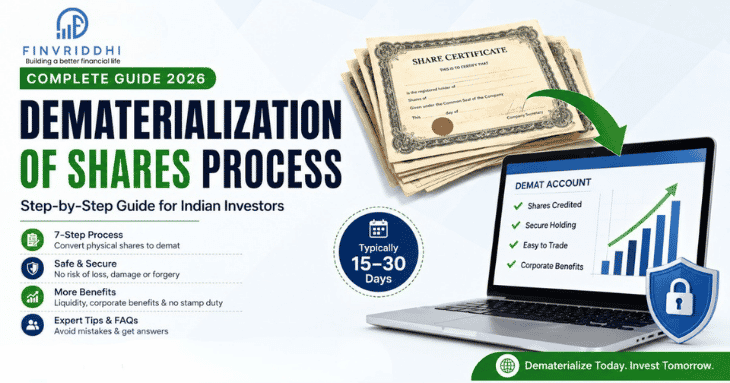
Dematerialization of Shares Process: Step-by-Step Guide for Indian Investors
Dematerialization of shares is the process of converting physical share certificates into electronic form stored in a demat account. In India, you submit your original certificates along with a Dematerialisation Request Form (DRF) to a Depository Participant (DP). The DP coordinates with NSDL or CDSL to complete the conversion, typically within 15–30 days.
TL; DR – What you’ll learn
- What dematerialization of shares actually means and why it matters now
- The exact documents you need before you start
- A 7-step process to convert physical certificates to demat form
- 5 key benefits that go beyond just convenience
- Expert tips most investors overlook (including IEPF recovery)
- 6 FAQs answered in plain language
Millions of Indian households are sitting on physical share certificates they can’t trade, transfer, or even verify. Some are tucked into old files; others were inherited from parents or grandparents who invested decades ago. If you’re one of them, this guide is written for you.
The dematerialization of shares process – converting paper certificates into digital holdings – is no longer optional in India. SEBI mandated that all securities must be held and traded in demat form. Since the Ministry of Corporate Affairs extended its Rule 9B deadline to June 30, 2025, even private companies are now covered.
In this guide, you’ll learn exactly what dematerialization means, which documents you need, how the process works step by step, and the most common mistakes that delay or derail the conversion. Whether you hold two certificates or two hundred, this walkthrough will give you the clarity to act – or hand it confidently to an advisor like Finvriddhi.
What Is Dematerialization of Shares?
Dematerialization of shares is the conversion of physical paper share certificates into electronic records held in a demat account with a Depository Participant. Once dematerialized, shares are stored digitally with NSDL or CDSL — India’s two central depositories — and can be bought, sold, or transferred electronically.
Before 1996, every share transaction in India involved physical paper. Certificates were printed, signed, stamped, and physically delivered — a process that took weeks and was prone to loss, forgery, and disputes. The Depositories Act of 1996 created NSDL (National Securities Depository Limited) and CDSL (Central Depository Services Limited) to solve this.
Think of a demat account the way you think of a bank account — except instead of money, it holds shares, bonds, and other securities. The physical certificates become irrelevant once your holdings are credited electronically. No risk of fire damage. No fear of a misplaced envelope. No forged signatures.
KEY TAKEAWAYS – WHAT IS DEMATERIALIZATION?
- Introduced in India through the Depositories Act, 1996
- NSDL and CDSL are the only two SEBI-regulated depositories in India
- Physical certificates remain legally valid but cannot be traded without dematerialization
- A Depository Participant (DP) is your gateway to dematerialization
Benefits of the Dematerialization of Shares Process
Dematerializing shares gives investors instant liquidity, protects against physical loss or forgery, eliminates stamp duty on transfers, makes inheritance far simpler, and unlocks dividends or bonuses from corporate actions that physical holders may have missed.
1. Instant Buy, Sell & Transfer
Once shares are in demat form, you can sell them on any stock exchange in seconds. Physical share transfers used to take 30–90 days and required physical delivery. Electronic settlement now happens in T+1 day under SEBI’s current framework.
2. Zero Risk of Physical Damage
Fire, flood, termites, or simple misplacement – physical certificates face real threats. Electronic records held with NSDL or CDSL are backed by multiple layers of security and have no such vulnerabilities.
3. Automatic Corporate Benefits
Dividends, bonus shares, rights issues, and stock splits are credited directly to your demat account. Physical shareholders often miss these benefits if their address records aren’t updated with the Registrar and Transfer Agent (RTA).
4. No Stamp Duty on Transfers
Physical share transfers attract stamp duty. Securities transferred electronically in demat form are exempt from stamp duty under Indian law — a tangible saving for investors who trade or gift shares frequently.
5. Simplified Inheritance & Transmission
When a shareholder passes away, transmitting demat shares to nominees or legal heirs is far less complicated than dealing with physical certificates. With a nomination already registered, the process can be completed in weeks rather than months.
6. Regulatory Compliance
Holding shares in demat form keeps you aligned with SEBI regulations. For private companies covered under MCA’s Rule 9B, failing to comply meant restrictions on new share issues, buybacks, and bonus shares — making dematerialization a legal necessity, not just a convenience.
What Documents Do You Need for Dematerialization?
To start the dematerialization of shares, you need your original share certificates, a completed Dematerialisation Request Form (DRF) from your Depository Participant, a copy of your PAN card, and an active demat account. Additional KYC documents like Aadhaar and address proof may be required at account opening.
Here is a consolidated checklist before you approach your Depository Participant (DP):
- Original share certificates — endorsed ‘Surrendered for Dematerialisation’ on the back
- Dematerialisation Request Form (DRF) — filled separately for each ISIN (company)
- PAN card copy — mandatory for all demat transactions
- Active demat account — linked to the same PAN as the certificate holder
- Aadhaar card or address proof — required if opening a new demat account
- Cancelled cheque or bank statement — for DP’s KYC requirements
COMPETITOR GAP CALLOUT — WHAT MOST ARTICLES MISS
Most articles on dematerialization stop at the basic document checklist. What they don’t tell you: if the name on the share certificate doesn’t exactly match the name on your PAN card — even a small difference like ‘Ramesh Kumar’ vs ‘R. Kumar’ — the DP will reject the request. You’ll need to get a name correction done with the RTA first. This single issue delays thousands of requests every year.
Step-by-Step Guide to the Dematerialization of Shares Process
The dematerialization of shares process in India has 7 key steps: open a demat account, collect the DRF from your DP, endorse and submit your original certificates, wait for DP verification, RTA confirmation, shares being credited to your account, and finally verifying your demat holdings online. The full process takes 15–30 days.
Step 1 Open a Demat Account with a Depository Participant (DP)
A Depository Participant is any SEBI-registered entity — a bank, stockbroker, or financial institution — authorized to offer demat services. Open an account and complete your KYC. Your account will be linked to either NSDL or CDSL. Without a demat account, there is no digital address for your shares to be credited to.
Step 2 Collect the Dematerialisation Request Form (DRF)
Obtain the DRF from your DP — either from their branch or online portal. Fill one DRF per ISIN (i.e., per company). If you hold certificates from five different companies, you need five separate DRFs. Mixing certificates from different companies in one DRF forces a resubmission.
Step 3 Deface and Sign the Original Share Certificates
Write ‘Surrendered for Dematerialisation’ on the face of each certificate. All joint holders must sign both the DRF and the back of each certificate. This step permanently renders the physical certificates unusable — a legal requirement before the DP will accept them.
Step 4 Submit DRF + Certificates to Your DP
Submit the signed DRF along with the defaced certificates to your DP’s branch or registered office. Collect an acknowledgment receipt. The acknowledgment is your legal proof of submission — protect it.
Step 5 DP Verifies and Sends to the Registrar & Transfer Agent (RTA)
Your DP verifies your KYC, processes the DRF, and sends a Dematerialisation Request Number (DRN) to the company’s RTA through NSDL or CDSL. This is where name mismatches or signature discrepancies get flagged and rejected.
Step 6 RTA Confirms and Destroys Physical Certificates
The RTA verifies the certificates against company records, approves the request, and physically destroys (mutilates) the paper certificates. Once the RTA destroys them, only the demat record exists. Save the DRN for future reference.
Step 7 Shares Are Credited to Your Demat Account
NSDL or CDSL credits the equivalent number of electronic shares to your demat account. Verify the holding on your DP’s portal or CDSL/NSDL’s investor portals. Always confirm the share count matches your original certificates.
KEY TAKEAWAYS — THE DEMATERIALIZATION PROCESS
- Process takes 15–30 working days if documents are complete and correct
- Submit one DRF per ISIN (company) — not one combined DRF for all shares
- Always get an acknowledgment receipt from your DP at the time of submission
- The Dematerialisation Request Number (DRN) is your tracking reference throughout
Physical Shares vs. Demat Shares: Key Differences
Physical shares are paper certificates prone to loss and forgery, and cannot be traded on stock exchanges. Demat shares are electronic holdings stored with NSDL or CDSL, offering instant tradability, automatic corporate benefit credits, and no risk of physical damage.
| Feature | Physical Shares | Demat Shares | Best For |
|---|---|---|---|
| Storage | Paper certificate (at home/locker) | Electronic record (NSDL/CDSL) | Demat — all investors |
| Tradability | Cannot be traded on exchanges | Instant buy/sell on any exchange | Demat — active investors |
| Loss Risk | High (fire, theft, damage) | None (encrypted digital storage) | Demat — all investors |
| Stamp Duty | Applicable on transfer | Not applicable | Demat — frequent traders |
| Corporate Actions | Manual update, often missed | Automatic credit to account | Demat — long-term holders |
| Inheritance | Complex — physical proof required | Streamlined with nominee facility | Demat — families with legacy wealth |
| Compliance | Non-compliant for trading (SEBI) | Fully compliant | Demat — mandatory for listed shares |
| Transfer Time | 30–90 days (physical delivery) | T+1 day (next business day) | Demat — all investors |
Expert Tips for Dematerialization of Shares
Key expert tips include verifying your name matches your PAN before submitting, checking for unclaimed dividends transferred to IEPF, tracing renamed or merged companies before assuming shares are worthless, and always keeping copies of every document you submit.
Tip 1: Always Match the Name Exactly Before Submitting
Compare the name printed on the share certificate character-by-character against your PAN card. Even minor differences — initials, middle names, punctuation — will result in rejection. Get a name correction done with the RTA first. This saves weeks of rework.
Tip 2: Check for IEPF Claims before Converting Old Shares
If dividends from your physical shares were unclaimed for 7 or more consecutive years, they — along with your shares — may have been transferred to the Investor Education and Protection Fund (IEPF). You can still reclaim them via an IEPF-5 claim form on the MCA portal. Many families discover substantial unclaimed dividends during this process. Always run a check before assuming your old shares are fully intact.
Tip 3: Trace Company Name Changes and Mergers
Old certificates often carry company names that no longer exist. The company may have merged, been acquired, or changed its name. Based on advisory experience at Finvriddhi, some certificates from the 1980s and 1990s carry far higher value today after accounting for stock splits, bonuses, and name changes. Always verify the current status via SEBI/NSDL records or the RTA before assuming a certificate is worthless.
Tip 4: Keep Copies of Everything You Submit
Before handing over original share certificates, photocopy both the front and back of each certificate. Save a copy of the signed DRF. Store these separately. In the unlikely event of a processing dispute, this documentation is your primary protection.
Tip 5: Add a Nominee to Your Demat Account Right Away
Once your shares are in demat form, register a nominee. Without a nominee, your heirs will need a court-issued succession certificate – a process that can take 12–24 months and involves significant legal fees. This single step protects your family’s financial interests.
Frequently Asked Questions
Q: What is the dematerialization of shares process in simple terms?
Dematerialization of shares is the process of converting physical paper share certificates into electronic records stored in a demat account. Instead of holding a paper document, you hold a digital entry confirmed by NSDL or CDSL – India’s two official depositories. The conversion is done through a Depository Participant (DP) such as a bank or registered broker, and typically takes 15–30 days once all documents are correctly submitted.
Q: How long does the dematerialization process take in India?
The dematerialization of shares process takes approximately 15–30 working days from the date of submission to your DP. Delays usually happen due to name mismatches between the certificate and PAN, incomplete DRF forms, or backlog at the Registrar and Transfer Agent (RTA). If documents are accurate and complete, most standard requests are processed within 3 weeks.
Q: What is the cost of dematerializing physical shares?
Most DPs charge a one-time dematerialization fee of ₹3–₹5 per certificate plus applicable taxes, and a flat annual maintenance charge (AMC) for the demat account ranging from ₹300–₹800 per year. Some DPs offer zero-AMC accounts. There is no stamp duty on shares transferred via dematerialization, which makes it cost-effective compared to physical transfers.
Q: Can I dematerialize shares of a company that has changed its name or merged?
Yes, shares of companies that have changed their name, merged, or been acquired can still be dematerialized in most cases. The RTA maintains records of corporate actions including name changes, mergers, and demergers. An expert like Finvriddhi can trace the current corporate status of your holdings, determine the right ISIN, and guide you through the dematerialization request.
Q: What happens if my physical share certificates are lost or damaged?
Lost or damaged share certificates do not mean lost value. The process involves filing a police FIR (for lost certificates), publishing a public notice in two newspapers, submitting an indemnity bond to the company or its RTA, and applying for duplicate certificates. Once duplicates are issued, they can be dematerialized using the standard DRF process. This typically takes 2–4 months.
Q: Is dematerialization mandatory in India?
For listed companies, SEBI has mandated that all securities must be held and traded in demat form. For private limited companies (except small companies), the MCA required compliance under Rule 9B of the Companies Act, 2013, with a deadline of June 30, 2025. Physical shares are still legally valid documents, but they must be dematerialized to be traded or transferred.
Q: Where can I get expert help for dematerialization in India?
Finvriddhi, based in Kalkaji, New Delhi, offers dedicated Physical Share Advisory Services across India for investors who need expert help with dematerialization, lost certificate recovery, IEPF claims, and transmission of inherited shares. Their team handles the entire paperwork process from verifying your holdings to coordinating with the RTA and DP. Reach them at +91 99992 05997 or visit finvriddhi.com.
Why Getting This Right Matters More Than You Think
The dematerialization of shares process might look like a paperwork formality. It is not. For millions of Indian families, physical share certificates represent real wealth – sometimes running into lakhs or crores – sitting idle, untradeable, and at risk of being permanently lost or transferred to IEPF.
Converting those certificates into electronic holdings takes less than a month when done correctly. The result: shares that can be traded instantly, dividends credited automatically, and a portfolio that your family can actually inherit without legal battles.
The process is not complicated. It is, however, unforgiving of small errors – a name mismatch, a missing signature, a forgotten DRF for one company. That’s where having an expert guide every step makes the difference between a smooth conversion and a months-long delay.
Whether you have two certificates or an entire box of them, the right time to start the dematerialization of shares process is now — before certificates deteriorate further, before more dividends lapse to IEPF, and before regulatory rules tighten further.
Also Read: Recover Old Physical Shares in India: Step-by-Step Guide for Investors
Unclaimed Dividends and Lost Share Certificates: What Investors Must Do
How to Turn Physical Shares into Demat and Claim Dividends Easily
Need Help with Dematerialization?
Finvriddhi’s Physical Share Advisory team has helped over 1,000 families convert, recover, and unlock the value of their physical share holdings across India.
+91 99992 05997 | www.finvriddhi.com | Kalkaji, New Delhi
Book a Free Consultation → finvriddhi.com/contact
No hard sell. No jargon. Just expert guidance, one step at a time.