Every investor wants strong returns, but not at the cost of sleepless nights and high volatility. The actual objective of investing is to increase wealth steadily and reduce risk significantly. Portfolio optimization entails the balancing of both risk and reward so that the investment performs consistently in different market cycles. With a certified financial consultant, investors will be able to develop an approach that emphasizes long-term returns instead of speculative gains.
Smart Ways to Optimize Your Portfolio for High Returns and Low Risk
Here are practical strategies to balance growth and stability for long-term investment success–
- Start with Clear Financial Goals
Portfolio optimization starts with clarity. Investors must define why they are investing, the duration, as well as the amount of risk they are capable of bearing. In the absence of such inputs, the investment decisions may tend to be random and emotional.
Some of the goals around which a financial planner would organize portfolios include retirement, wealth creation, the education of children, or passive income. This is a goal-oriented technique that ensures the investments are always meaningful and in line with the long-term financial priorities.
- Diversification Is the First Layer of Risk Control
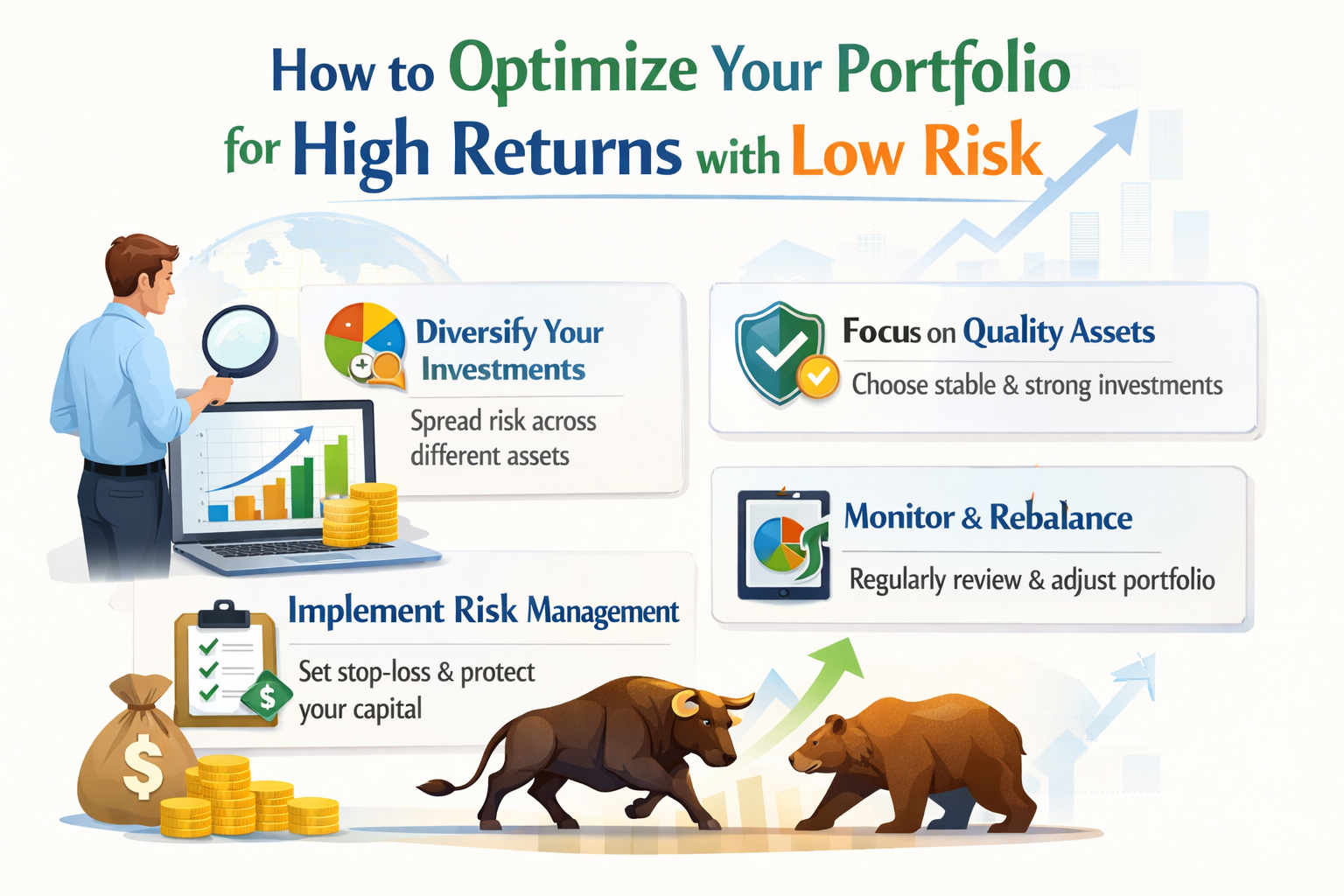
Diversification spreads investment in different asset categories like equities, debt, gold and hybrid products. This helps create a portfolio that is not dependent on one individual asset and cushions the portfolio against extreme market changes.
A professional investment advisor evaluates how each asset contributes to risk and return, ensuring the portfolio remains balanced. Debt or gold can be used when equities are not performing well and stabilize the performance.
- Asset Allocation Drives Portfolio Performance
The choice of assets is more significant than individual stocks or funds. A combination of equity, debt and alternative investments is the right mix that defines the behavior of a portfolio in various market conditions.
A financial advisor develops the asset allocation depending on the age, the stability of the income, the riskiness and the financial objectives. Younger investors may hold greater equities, while conservative investorsmay prioritize more debt and stable instruments.
- Use Mutual Funds for Managed Risk Exposure
Mutual funds offer diversification and professional management, hence are best suited when it comes to the most optimized portfolios. They enable investors to trade in markets without having to deal with securities.
A mutual fund advisor assists in the identification of appropriate equity-based funds, debt-based funds, and hybrid funds based on performance, the expense ratio, and investment approach. This minimizes chances of not selecting the right people and enhances long-term performance.
- Tax Efficiency Enhances Net Returns
High returns will be of no value if taxes significantly reduce them. Portfolio optimization requires tax planning. The gains are preserved by the structuring of investments in tax-efficient instruments.
An informed tax consultant would make sure that investments are made according to tax laws and would maximise the after-tax returns. Some of the strategies can be tax-saving funds, capital gain planning and withdrawal optimization.
An experienced tax planner incorporates tax considerations into the investment strategy to ensure that the returns remain meaningful in the long-term.
- Rebalancing Keeps Risk in Check
Over time, asset allocation changes with market shifts. Increasingly, an equity market can expand equity exposure to greater levels than the desired which will lead to an increase in risk.
A financial consultant will engage in periodic rebalancing to achieve the desired allocation. This is done by selling off assets that are performing well and redeploying to underweighted assets, with the portfolio always remaining within the risk-taking.
- Focus on Consistency, Not Market Timing
Trying to predict market highs and lows often leads to poor decisions. Regular investment, especially systematic investment, can enable the investor to gain out of the market cycles without exposing themselves to unnecessary risks.
A certified financial advisor insists on disciplined investing as opposed to market noise. Compounding works well when one remains invested over the cycles.
- Risk Assessment Should Be Continuous
Risk is not static. Portfolio performance is influenced by economic changes, interest rates, personal income and market trends. Continuous assessment keeps investors ready.
A financial planner periodically reviews the investment exposure, identifies the risk emerging and recommends changes to the exposure. This active set of actions will avoid any shock and lead to consistent development.
Conclusion
Effective portfolio management to achieve the best returns with minimal risks involves planning, discipline and constant reviewing. The main pillars of a resilient investment plan are diversification, asset allocation, tax efficiency, and rebalancing periodically. With the help of a certified financial planner, investors are able to create portfolios that grow gradually while remaining protected against uncertainty.
Build a stronger, low-risk investment portfolio with Finvriddhi’s expert guidance and personalized financial planning.